In servo stepper motion control, the driver is the piece that converts step pulses into smooth, controlled motion. If you're assembling a new axis or upgrading an existing one with NEMA 17, 23, or 34 steppers, the DM556 Digital Stepper Motor Driver deserves a close look. The key is matching its input voltage, current range, and micro-step settings to your power supply and controller.
Quick verdict
The DM556 gives you a well-rounded set of specs for the price. It outputs 1.4A to 5.6A, accepts 20V to 50V DC, and supports micro-step resolution up to 25,600 steps per revolution. If you already have a compatible DC supply and a controller that can send clean pulses, it's a practical choice for many NEMA 17, 23, and 34 motors.
Who it suits
This driver is built for people who need to control a 4-wire, 6-wire, or 8-wire stepper motor with flexible settings. It works in applications like dispensing, woodworking, welding, screw driving, winding, placement, packaging machines, and LED equipment. If you're comfortable setting DIP switches to match your motor's current and resolution, you'll feel at home here.
What stands out
The DM556 accepts pulse input up to 200 kHz, which helps it handle fast step rates from your controller. Its 16 selectable micro-step resolutions range from 400 to 25,600 steps per revolution, so you can tune for smoothness or speed. The 8 selectable output current settings, spanning 1.4A to 5.6A, make it easy to pair the driver with motors in the NEMA 17, 23, and 34 size range.
Meaningful trade-offs
The input voltage range is 20V to 50V DC, with typical operation at 24V to 48V DC. That means a 12V supply won't cut it; you'll need a power source that sits inside that window. Also, because the driver can use very fine micro-step settings, your motion controller must be capable of generating the corresponding pulse rate. The 200 kHz input limit is generous, but it only matters if the rest of your system can match it.
Remember too that the DM556 is a driver module, not a full controller. You still need a stepper motor, a step/direction signal source, and a DC power supply in the loop. Budget for those parts too.
Bottom line
At $18.52, the DM556 Digital Stepper Motor Driver delivers a wide current range, high micro-step resolution, and a broad input voltage window. It's best for someone who already has a 20-50V DC supply and a controller that can produce clean step pulses. If your setup fits those requirements, it's a straightforward way to drive a NEMA 17, 23, or 34 motor.
DM556 Digital Stepper Motor Driver 20-50V DC Max 5.6A Fit for Nema 17/23/34
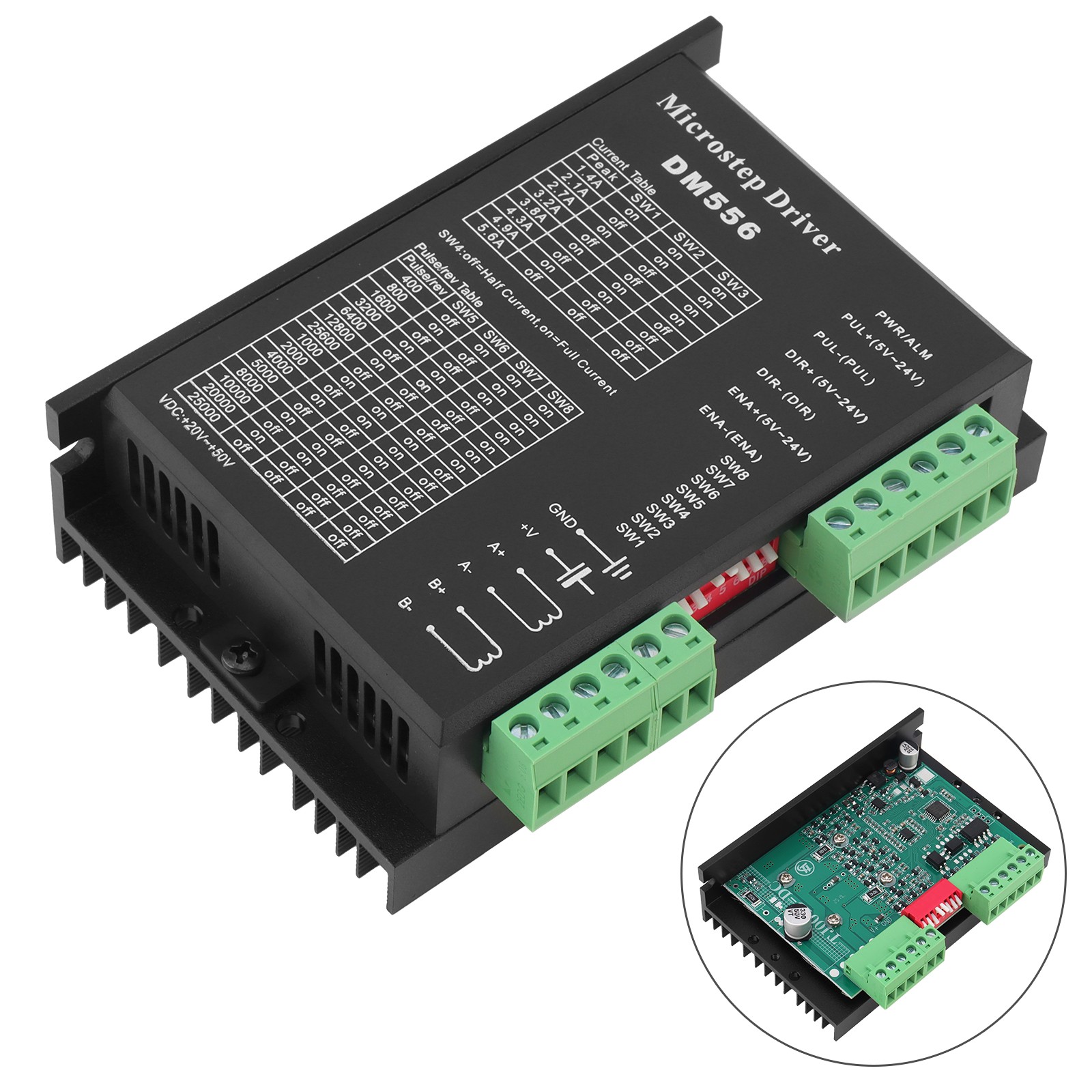
The driver's biggest draw is the flexible output current from 1.4A to 5.6A and the high micro-step resolution, which lets you adjust performance to your motor. On the other side, you need to respect the 20V minimum input; if your power supply puts out less than that, this driver won't run.