If you are planning a remote monitoring or control node and keep going back and forth between PLCs, industrial PCs, and IoT boards, the decision usually comes down to connectivity and I/O. The ESP32 Edge Controller tries to cover both in a single board, with wired Ethernet, 4G, serial ports, and relay outputs all on one compact design.
Quick Verdict
This is not a full industrial PC in the traditional sense, but it is a practical edge controller for projects where you need to move data from sensors or legacy serial equipment to the network or cloud while keeping the ability to switch an output locally. At USD 37.58, the feature set is dense for the price. It is best for makers, automation integrators, or small SCADA nodes that need flexible connectivity without a large enclosure full of separate gateways.
Who It Suits
- Remote equipment monitoring - The 4G Cat.1 module gives you an always-connected path when wired internet is not available.
- Serial-to-network bridging - RS485 and RS232 ports let you connect older industrial meters, drives, or controllers to a modern TCP/IP network.
- Simple relay control - Two relay outputs rated 10A at 250V AC can switch lights, pumps, fans, or signal horns.
- Prototyping to pilot - If you are testing an edge-computing idea and want a board that can move to a permanent install, this covers a broad range of connectivity options.
The main limitation is the small I/O count. You get 2 digital inputs and 2 relay outputs, so if your application needs many analog channels or high-density digital I/O, you would need to add an external I/O module.
What Stands Out From the Listed Details
The controller is built around the ESP32-32E-N4 module, which already gives you WiFi and Bluetooth for short-range connections. On top of that, the board adds wired networking through an LAN8720A 100Mbps Ethernet transceiver and a 4G Cat.1 module with a built-in flip-top Nano SIM slot and SMA antenna interfaces. That means you can choose how the device reaches the outside world: Ethernet, WiFi, or cellular.
For industrial communication, the RS485 and RS232 transceivers are important because they allow direct connection to many types of field equipment without needing a separate USB-to-serial converter. The digital inputs are optocoupler-isolated, which helps reduce noise in industrial environments. The relay outputs include diode discharge protection, and the power supply range of DC 8-36V gives you flexibility for common 12V or 24V industrial power rails.
Power is delivered through a Type-C port, which is convenient for bench testing, or through the terminal block for permanent wiring.
Meaningful Trade-Offs
- Limited I/O - With only 2 digital inputs and 2 relay outputs, this is not a replacement for a PLC with extensive I/O. It is a connectivity-focused edge controller.
- ESP32 ecosystem - You are working within the Arduino/ESP-IDF software world, which is fine for many engineers but a different workflow than traditional SCADA programming.
- 4G is Cat.1 - This is fine for moderate data rates and low-power telemetry, but if you need high-bandwidth video or frequent large file transfers, Cat.1 is not the right class.
- Price vs. capability - At USD 37.58, the price is low for the feature set, but you still need to budget for a SIM card, antenna, and possibly an enclosure or DIN rail mounting solution.
Bottom Line
Choose the ESP32 Edge Controller when your priority is getting multiple connectivity paths into one small board and you need a small number of relay outputs and isolated digital inputs. It is a smart fit for SCADA-style telemetry, remote control, and custom IoT gateways where Ethernet might not always be available and 4G is your backup or primary link.
ESP32 Edge Controller Ethernet/WiFi/BT/4G RS485/232 2DI/2DO Relay Type-C/DC8-36V
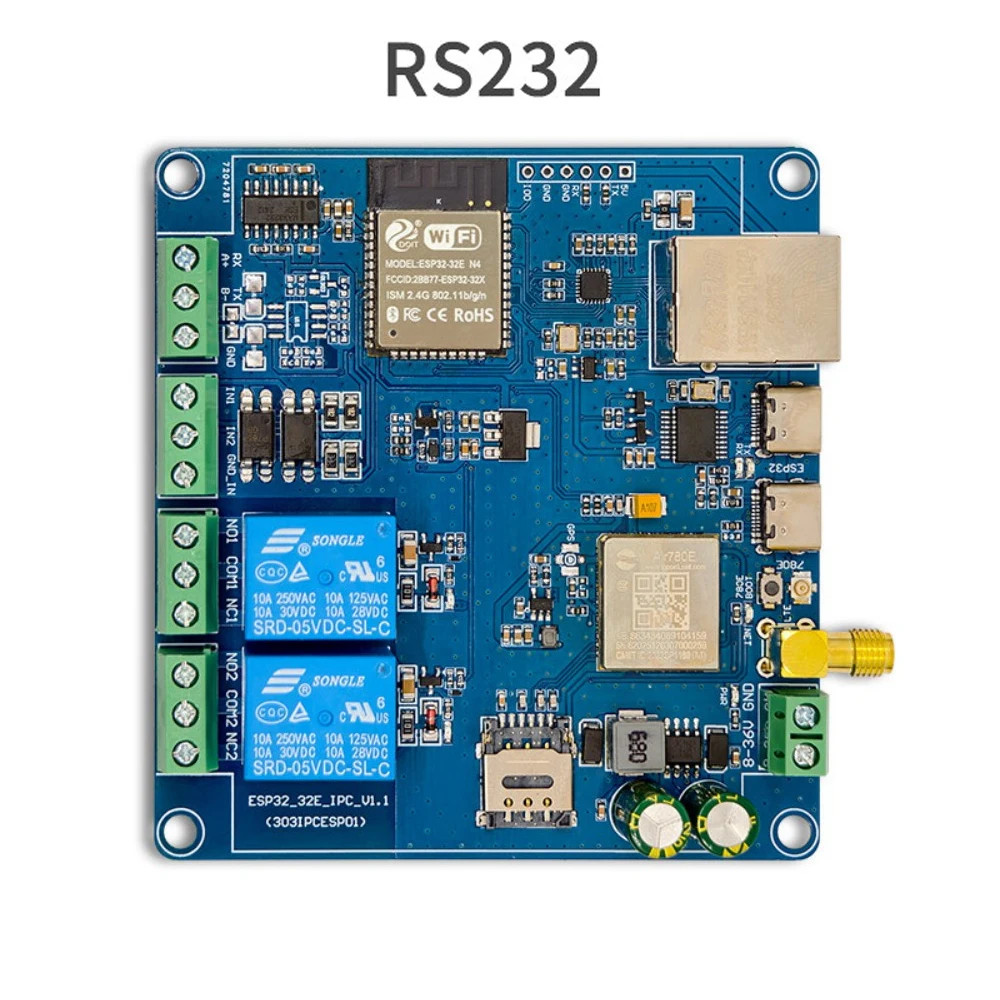
The listed details show a compact board that brings together wired Ethernet, WiFi, Bluetooth, 4G Cat.1, RS485, RS232, two optocoupler-isolated digital inputs, and two relay outputs. The built-in Nano SIM slot and SMA antenna connections make it easy to get cellular connectivity started. The 8-36V DC input range gives you houseroom for battery or industrial supply use.
If you need a small, connected edge controller and you are comfortable handling the I/O count, this is a strong candidate to build a custom remote monitoring or control node. For projects with more demanding I/O requirements, you would expand with additional hardware, but as a starting point for SCADA edge control, it brings the essential interfaces together in one package.