When you're evaluating industrial robotics cobots, the first big fork is whether you need a traditional robot arm or one built for safe work alongside people. Price and the way you expect humans and robots to share space usually settle the argument. The condition of the unit and what's included in the purchase also matter, because those affect how quickly you can get the arm moving. Two very different arms from Nachi and AUBO show how those factors point in opposite directions.
Quick Verdict
If budget is the main constraint and you want a complete package, the Nachi MZ07 (USD 7,999.99, 7 kg payload) is a compelling route. If you need a collaborative design with a 10 kg payload, the AUBO i10 (USD 22,000.00) is worth the higher spend.
Comparison
| Feature | Nachi MZ07 | AUBO i10 |
|---|---|---|
| Price | USD 7,999.99 | USD 22,000.00 |
| Condition | Used | New - Open box |
| Payload | 7 Kg | 10 Kg |
| Axis count | 6-axis | 6-axis |
| Type | Robotic Arm Assembly | Robotic Arm Assembly |
Where Each Product Wins
The Nachi MZ07 wins for buyers who want a single-package solution: it includes the CFD controller and teach pendant, so you can start programming without hunting for additional hardware. The used price undercuts the AUBO by a wide margin, leaving budget headroom for other automation components. That makes it a strong candidate for test cells, R&D benches, and lighter production tasks. The AUBO i10 wins for operations that need to move heavier objects and do it near people. Its hand-guide operation and power/force limiting make it a better fit for shared workspaces, and the arm design reaches into tasks like machine tending or packaging lines.
Product Notes
Nachi MZ07 6-Axis Industrial Robot Arm W/ CFD Controller & Teach Pendant 7kg
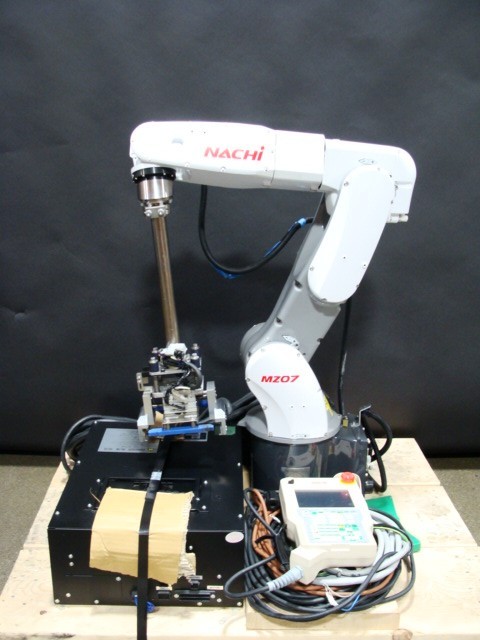
The Nachi MZ07 is a complete robot arm package that pairs the arm with the CFD controller and teach pendant. The included control system eliminates a major integration step, which is a real advantage when you're setting up a test cell or a small automation line. As a robotic arm assembly, it fits into processes that already have end-of-arm tooling or other peripherals. The main thing to weigh is the used condition. For test benches and lighter handling jobs, that trade-off can be entirely reasonable. If your parts are small and your budget is fixed, this package gives you a lot of working capability without a separate controller purchase. That makes it a sensible entry point for teams automating their first robot station.
AUBO i10 Collaborative Robot
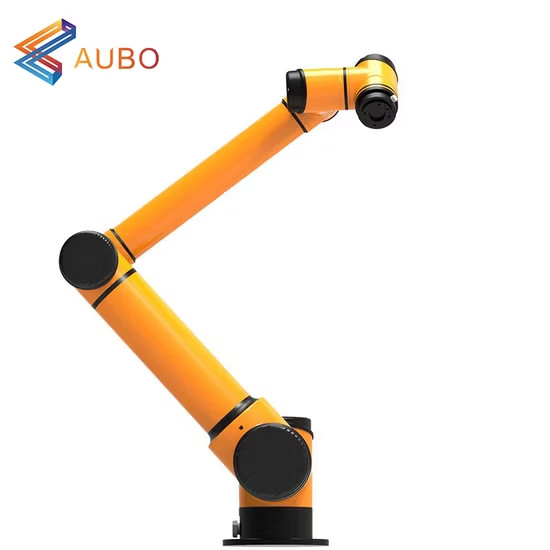
The AUBO i10 is a collaborative robot with a design centered on human-robot interaction. It offers hand-guide operation and power and force limiting, making it suitable for tasks such as welding, packing, and other industrial automation work where people and robots share floor space. Since it comes in new-open-box condition, you get a unit with less previous duty than a used arm. The trade-off is the asking price, which sits significantly above the Nachi package. For teams that want to run a cobot safely next to people, the extra cost buys a collaborative feature set and a higher workload ceiling. That makes the i10 a better fit for shared-space applications. It shifts the planning focus from guarding to cooperation.
Final Choice by Use Case
Choose the Nachi MZ07 when a tight budget is the deciding factor. Choose the AUBO i10 when you need a safety-focused design and a higher workload ceiling. If you're still unsure, map the weight of your parts and how close people will stand to the robot; that will usually tell you which of these two arms belongs on your floor.